

When you first look at a piece of jewellery, its sparkle may attract your attention. But what makes you continue admiring it is something deeper: the refinement of its colour, the precision of its stone setting, the smoothness of its finish and the confidence with which it can be worn.
Premium gold-plated jewellery is not defined by how loud or elaborate it appears. Its quality becomes visible through the smaller details that make the entire piece feel considered, balanced and beautifully finished.
As the founder of Jyoti Luxe, I have always loved jewellery that makes a woman feel beautifully dressed without overwhelming her personality.
“Over the years, I have learned that jewellery looks premium not because it is loud, but because every detail—from the stone setting to the final polish—feels thoughtfully finished.”
This distinction matters when you are selecting jewellery for a wedding, festival, family celebration or special evening. Two pieces may appear similar in photographs, yet look and feel completely different when you examine them closely.
Here are seven quality details you should consider before choosing premium gold-plated jewellery.
1. A refined and balanced gold tone
The first quality you are likely to notice is the colour of the gold finish.
A premium gold tone should feel warm, refined and visually balanced. It should complement Indian skin tones and traditional or contemporary occasion wear without appearing excessively bright, orange or unnaturally yellow.
The right gold tone also helps jewellery coordinate elegantly with:
- zari work;
- gold embroidery;
- champagne and ivory outfits;
- deep jewel tones;
- silk sarees;
- bridal and festive lehengas; and
- traditional wedding attire.
Why the gold tone matters
An overly yellow or uneven finish can make an otherwise attractive design appear less sophisticated. A well-balanced finish allows the design, stones and craftsmanship to be noticed together.
When inspecting gold-plated jewellery, look for:
- consistent colour across the visible surface;
- even coverage around curves and edges;
- no obvious dark or unfinished patches;
- a tone that works naturally with the design; and
- visual harmony between the plating, stones and decorative elements.
It is also important to understand what “gold-plated” means. Gold-plated jewellery has a layer of gold finish over a base metal. It is not solid-gold or hallmarked gold jewellery unless a product description expressly states otherwise.
Similarly, “22K gold-plated” refers to the gold-plated finish—not the composition of the complete jewellery piece.
Transparent product information helps you appreciate premium gold-plated jewellery for what it genuinely offers: a luxurious gold appearance, beautiful design and celebration-ready elegance without presenting it as solid gold.
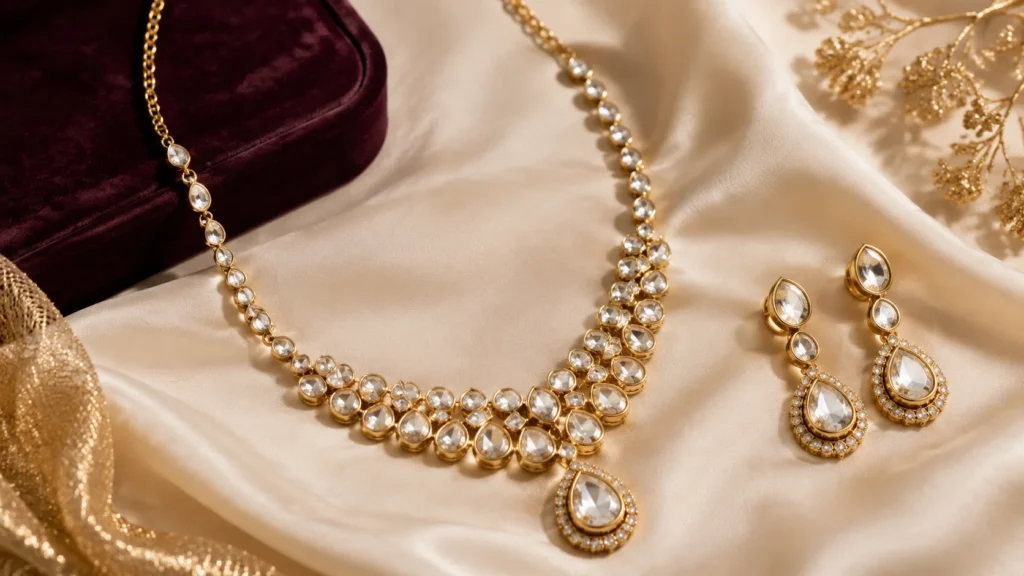
2. Brilliant and neatly set stones
Stones are often the visual centre of American Diamond, Kundan and other designer jewellery. Their quality should therefore be judged not only by how brightly they sparkle but also by how carefully they have been selected and set.
American Diamond—often referred to as AD or CZ—usually describes simulated diamond-style stones such as cubic zirconia. These are not natural or laboratory-grown diamonds unless specifically identified and documented as such.
High-quality American Diamond jewellery can nevertheless create beautiful brilliance when the stones are:
- clear and well cut;
- matched in colour and proportion;
- arranged symmetrically;
- positioned neatly;
- securely held; and
- selected appropriately for the design.
Look beyond sparkle
Strong lighting can make almost any reflective stone sparkle in a video. To judge the quality more accurately, examine how the jewellery looks under normal or natural light.
Ask yourself:
- Do the stones appear clear rather than cloudy?
- Are they aligned properly?
- Is the spacing between them consistent?
- Do they appear firmly set?
- Is the sparkle refined or excessively harsh?
- Does the arrangement enhance the design?
For Kundan or decorative stone jewellery, modest differences in shape, shade or placement may be part of its handmade character. The important consideration is whether the overall work appears harmonious and materially consistent with the product description.
A premium design does not need the maximum possible number of stones. It needs the right stones placed thoughtfully.
3. Smooth polishing and clean finishing
Finishing is one of the clearest differences between jewellery that merely photographs well and jewellery that feels premium when held in your hand.
Examine more than the front surface. Look carefully at:
- edges;
- joints;
- curves;
- corners;
- stone borders;
- enamel work;
- decorative motifs;
- connecting rings; and
- areas around clasps and hooks.
Premium gold-plated jewellery should generally feel smooth and thoughtfully finished. It should not have obvious rough patches, sharp projections, excessive adhesive, uneven colour or careless soldering.
Why finishing affects the complete look
Fine finishing helps light move smoothly across the jewellery. It makes the design appear more polished and allows even an elaborate piece to feel elegant rather than visually untidy.
Clean finishing also matters when the jewellery comes into contact with:
- your skin;
- delicate fabrics;
- embroidered outfits;
- saree pallus;
- dupattas; and
- styled hair.
An attractive necklace that scratches the skin or catches repeatedly on fabric may not feel luxurious in actual use.
Because many designer pieces are handmade or hand-finished, tiny variations may naturally occur. A minor variation is different from visibly careless workmanship. The complete piece should still feel balanced, refined and consistent with what was shown.
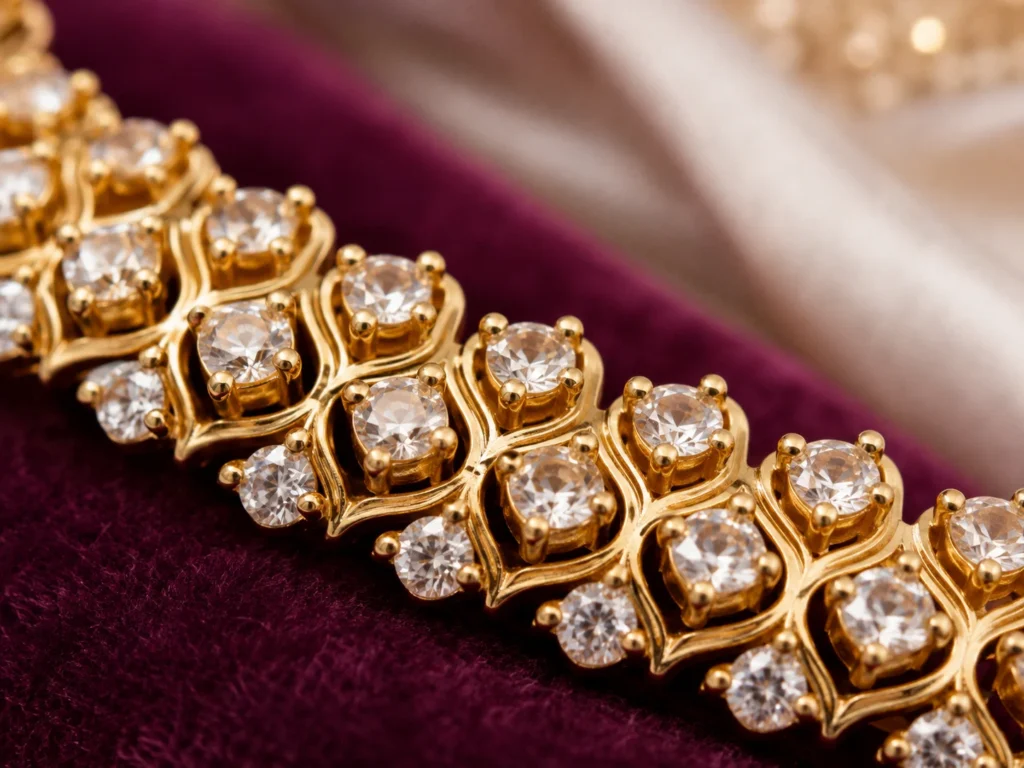
4. Secure clasps, hooks and stone settings
A piece of jewellery should feel as dependable as it looks beautiful.
Clasps, hooks, chains, links and stone settings may not receive as much attention as the main design, but they are essential indicators of construction quality.
Before purchasing or wearing a piece, check whether:
- the clasp opens and closes properly;
- the hook feels secure;
- chain links are joined correctly;
- connecting rings are closed;
- earring posts appear straight;
- pushbacks fit securely;
- stones do not appear loose;
- hanging elements are attached firmly; and
- the product can be worn without excessive force.
Why construction details matter
Celebration jewellery is often worn for several hours. It may be exposed to movement, dancing, outfit changes, travel and repeated handling. Secure construction helps you wear it with greater confidence.
For stone settings, check whether the stones are held evenly. Prongs should not appear unnecessarily raised or likely to catch on fabric.
For earrings, examine:
- posts;
- backs;
- hooks;
- connecting loops; and
- the attachment between the decorative front and the wearable component.
For necklaces and bracelets, inspect:
- clasps;
- extension chains;
- fastening loops;
- flexible joints; and
- links carrying heavier decorative elements.
Even the most beautiful design can become impractical if these components have been treated as an afterthought.
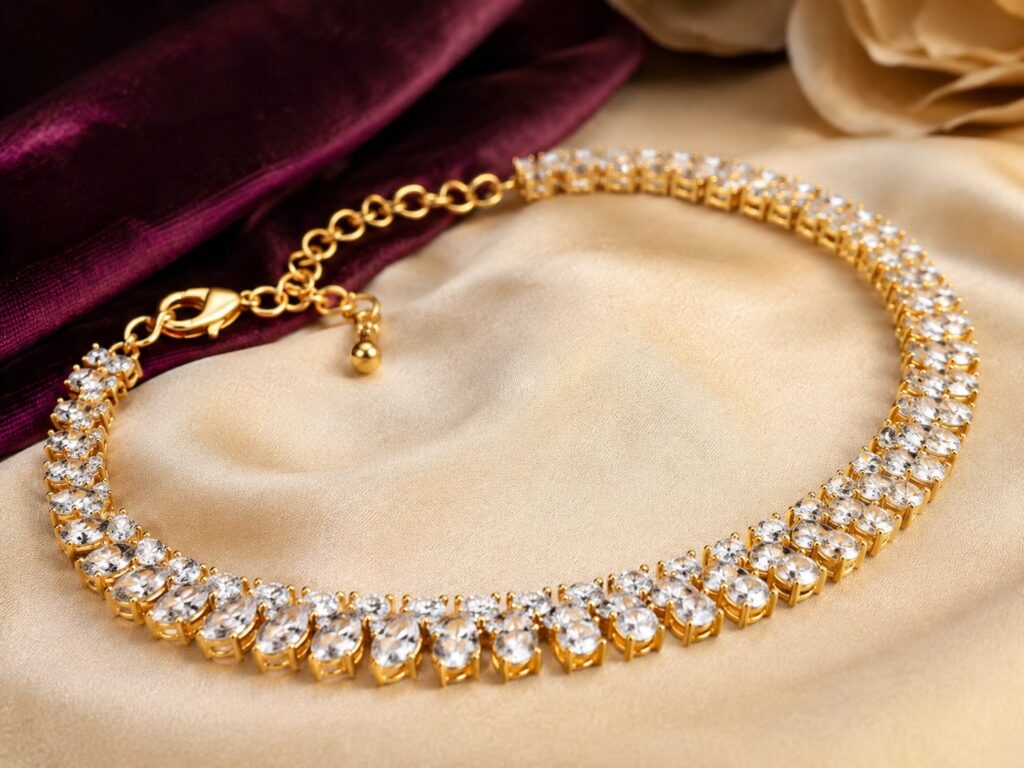
5. Comfortable construction and thoughtful weight distribution
Premium jewellery should not only look impressive—it should also be thoughtfully constructed for the way it will actually be worn.
A substantial design may naturally have some weight. The important question is whether that weight has been distributed intelligently.
What thoughtful construction feels like
A well-designed necklace should sit with reasonable balance rather than constantly turning, lifting or placing pressure on one narrow point.
Earrings should feel appropriately supported for their size. A statement pair may be heavier than everyday studs, but the design should not feel unnecessarily unbalanced.
When considering comfort, look at:
- total product weight;
- distribution of weight;
- flexibility at connecting points;
- smoothness against the skin;
- size and placement of earring backs;
- necklace-chain support;
- adjustability; and
- how naturally the product follows the body.
Choose according to your occasion
Your comfort requirements may change with the event.
For a short formal appearance, you may be comfortable wearing a heavier statement piece. For a long wedding function involving travel, ceremonies and dancing, you may prefer jewellery that offers visual richness with more manageable construction.
This does not mean that premium jewellery must always be lightweight. Bridal and heritage-inspired pieces may intentionally feel substantial. Premium quality means that the construction is appropriate for the design and intended occasion.
If you are buying online, review the available dimensions and approximate weight. When necessary, ask for a close-up or wearing video to understand the scale and movement more accurately.
6. A well-designed back and underside
Many customers naturally evaluate only the front of a jewellery piece. However, the back and underside can reveal a great deal about its overall craftsmanship.
Turn the jewellery over and examine:
- the structure behind the stones;
- the neatness of the setting;
- the finishing around joints;
- the smoothness of surfaces touching the skin;
- support given to larger decorative sections;
- the quality of connecting components; and
- whether the construction appears stable.
Why the back deserves attention
The underside affects:
- comfort;
- strength;
- flexibility;
- how the jewellery rests;
- how securely the stones are supported; and
- whether it catches on skin or fabric.
A thoughtfully designed back does not necessarily need to be highly decorative. It needs to be clean, functional and appropriate for the piece.
Open-backed stone settings may be used to allow more light through the stones, while closed structures may support a particular design or traditional finish. Neither is automatically superior. What matters is whether the construction is neat, secure and suited to the product.
Premium gold-plated jewellery should feel considered as a complete object—not designed only for a front-facing photograph.
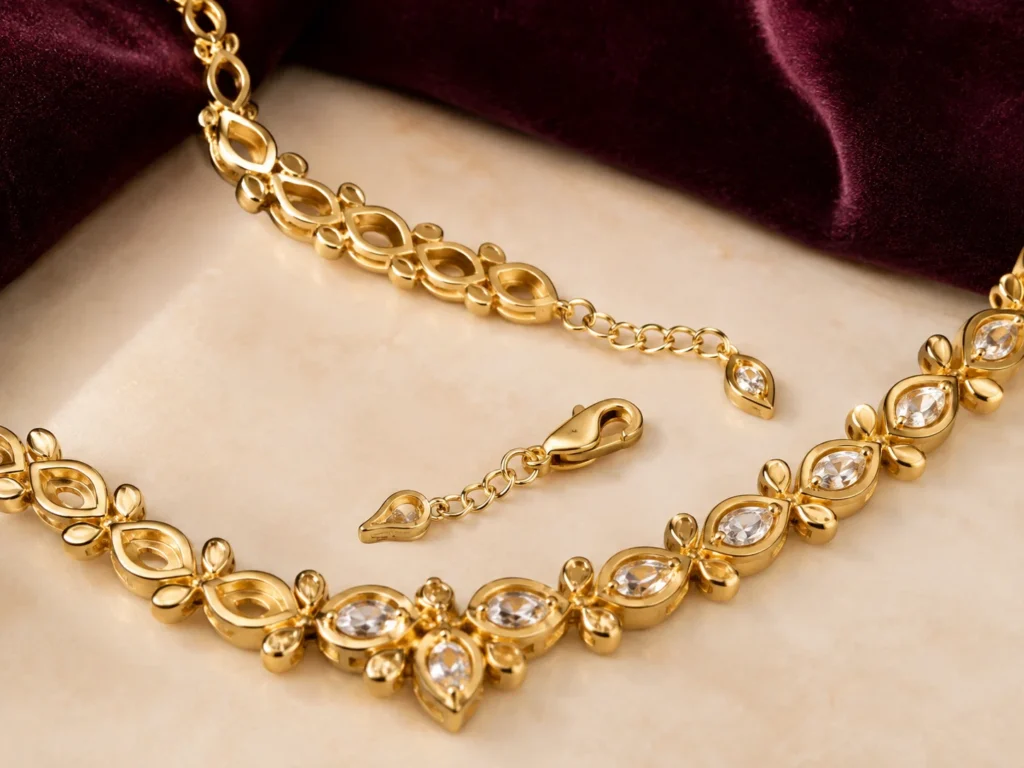
7. Accurate information, care guidance and trustworthy service
True quality is not limited to the physical product. It also includes the honesty and service surrounding it.
A trustworthy jewellery brand should help you understand what you are purchasing.
Look for product information covering:
- type of jewellery;
- plating or finish;
- base metal, where applicable;
- stone type;
- approximate dimensions;
- approximate weight, where relevant;
- products and accessories included;
- care requirements;
- photographs or videos; and
- applicable return or support conditions.
Transparency creates confidence
A brand should not describe gold-plated jewellery as solid gold. American Diamond jewellery should not be presented as natural or laboratory-grown diamond jewellery.
Similarly, broad claims such as “permanently anti-tarnish”, “waterproof”, “allergy-free” or “lifetime finish” should be treated carefully unless they are supported by appropriate product testing or documentation.
Honest information allows you to make a confident choice according to your needs, preferences and intended occasion.
Service is part of the product experience
Trustworthy service also includes:
- answering product questions clearly;
- sharing additional photographs or videos where practical;
- communicating processing and delivery expectations;
- packaging the product carefully;
- providing care guidance;
- responding to eligible problems; and
- explaining return, exchange and refund conditions transparently.
At Jyoti Luxe, the purpose is not merely to offer jewellery. It is to help women feel beautifully and distinctively dressed for the celebrations that matter to them.
That confidence begins before the jewellery is worn—with accurate information and a buying experience you can trust.
A quick quality checklist before you buy
Before choosing premium gold-plated jewellery online, ask these questions:
- Is the gold tone refined and even?
- Are the stones clear, aligned and securely set?
- Does the polishing appear smooth and clean?
- Are the clasps, hooks and links constructed properly?
- Is the weight appropriate for the intended occasion?
- Does the back appear neat and functional?
- Are the plating, stones, dimensions and inclusions clearly described?
- Are realistic photographs or videos available?
- Are care instructions provided?
- Does the brand explain its return and support policies clearly?
If most of these questions can be answered confidently, you are in a stronger position to select jewellery that feels premium beyond the first photograph.
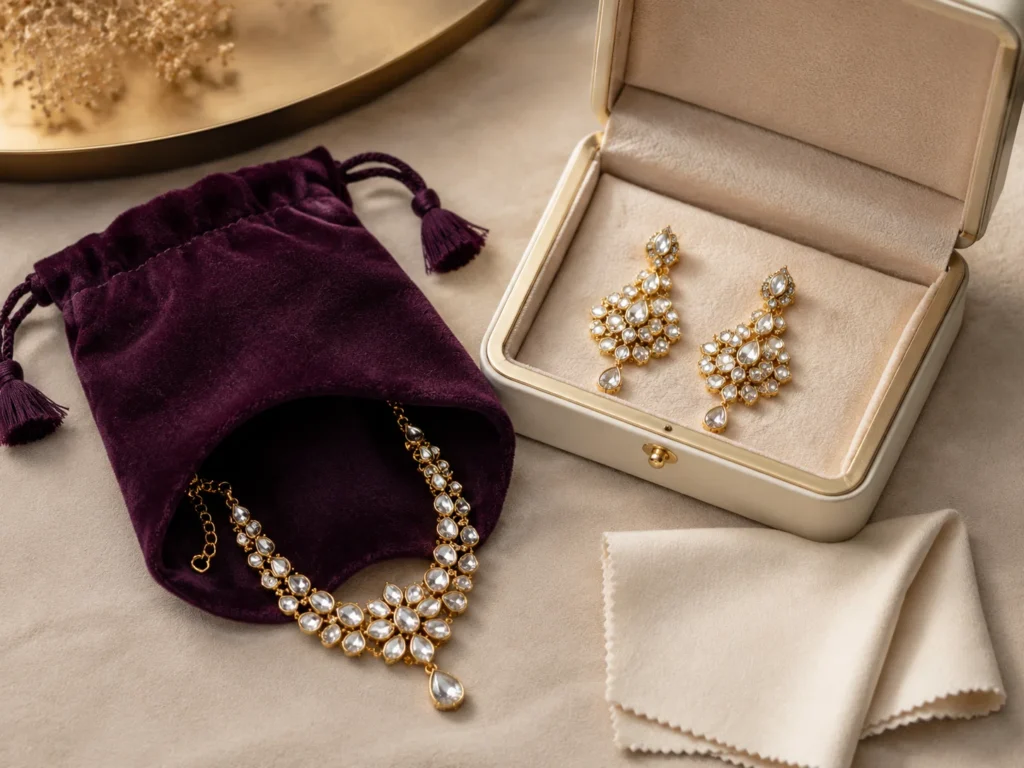
How to preserve gold-plated jewellery
Even high-quality plating requires appropriate care. The appearance and longevity of gold-plated jewellery depend on frequency of wear, skin chemistry, climate, moisture, handling and storage.
To help preserve its finish:
- apply perfume, cosmetics and hair products before wearing jewellery;
- avoid spraying perfume directly onto the product;
- keep it away from water, soap, sanitiser and cleaning chemicals;
- remove it before bathing, swimming, exercising or sleeping;
- wipe it gently with a clean, soft and dry cloth after use;
- avoid abrasive cleaners and polishing materials;
- store each piece separately;
- keep chains untangled;
- protect stonework from impact; and
- store jewellery in a dry pouch or box.
Gold plating is a surface finish and will not remain unchanged indefinitely. Careful handling can, however, help preserve its colour, shine and beauty for longer.
Final thoughts
The most beautiful jewellery does more than sparkle. It brings together proportion, refinement, craftsmanship, comfort and trust.
When choosing premium gold-plated jewellery, look beyond the front-facing photograph. Examine the tone of the plating, the clarity and placement of the stones, the finishing, the clasps, the comfort and the underside. Just as importantly, consider whether the product information and service help you make an informed decision.
Premium jewellery does not need to shout for attention. Its quality is felt in how naturally every detail comes together—and in how confidently you can wear it.
That is the philosophy behind Jyoti Luxe:
Beautifully Dressed, Unmistakably You.
Frequently asked questions
1. Is premium gold-plated jewellery made of solid gold?
No. Gold-plated jewellery has a layer of gold finish applied over a base metal. A description such as “22K gold-plated” refers to the plating or surface finish, not to the entire product being made of solid 22K gold.
2. What is American Diamond jewellery?
American Diamond, also called AD or CZ jewellery, generally uses simulated diamond-style stones such as cubic zirconia. These stones are not natural or laboratory-grown diamonds unless expressly identified and documented as such.
3. How can I identify high-quality gold-plated jewellery?
Look for a balanced gold tone, even plating, clear and securely set stones, smooth polishing, reliable clasps, comfortable construction, a neatly finished underside and accurate product information.
4. How long does gold-plated jewellery last?
There is no single fixed duration. Longevity depends on plating quality, frequency of wear, skin chemistry, moisture, chemicals, climate, handling and storage. Appropriate care can help preserve its appearance for longer.
5. Can gold-plated jewellery be worn every day?
Some designs may be suitable for frequent wear, but regular exposure to perspiration, water, perfume, sanitiser and friction can affect the plating more quickly. Follow the product-specific care instructions and choose the wearing frequency according to the design.
6. Why does some gold-plated jewellery look excessively yellow?
Gold tone can vary according to plating, finishing, lighting and photography. A refined piece generally uses a balanced tone that complements its stones, design and intended styling rather than appearing unnaturally bright.
7. What should I check when buying gold-plated jewellery online?
Review the plating and material description, dimensions, approximate weight, stone type, product inclusions, photographs, videos, care guidance, shipping information and return conditions. Ask questions if an important detail is unclear.