
Have you ever taken out your favourite gold-plated necklace, earrings or ring and noticed dark marks on it?
You may wonder:
“Why has my jewellery turned black—and could I have prevented it?”
The good news is that you can often slow down early tarnishing by changing a few simple habits.
Gold-plated jewellery needs different care from solid-gold jewellery. It has a layer of gold over another jewellery metal. That beautiful outer layer may slowly wear when it comes into contact with sweat, water, perfume, chemicals or repeated friction.
This does not mean that you should be afraid to wear your jewellery. It simply means that you should understand its finish and care for it correctly.
In this guide, you will learn how to prevent gold-plated jewellery from turning black, especially in India’s hot and humid weather. You will also learn:
- why plated jewellery changes colour;
- which everyday habits can harm the finish;
- how to clean it safely;
- how to store it correctly;
- what to do if it has already turned black; and
- how to choose thoughtfully finished jewellery.
A beautiful finish deserves thoughtful care. Small habits can make a meaningful difference to how long your jewellery keeps its glow.
Key takeaways
If you need the short answer, follow these rules:
- Wear your jewellery after applying perfume, makeup and creams.
- Remove it before bathing, exercising, swimming or sleeping.
- Keep it away from sanitiser and household cleaners.
- Wipe it gently after every wear.
- Allow it to dry fully before storage.
- Store every piece separately in a soft pouch or lined box.
- Do not use toothpaste, lemon, vinegar or baking soda for cleaning.
- Avoid unnecessary rubbing between different jewellery pieces.
- Take extra care during hot summers and humid monsoons.
- Buy from sellers who provide clear product and care information.
What is gold-plated jewellery?
Gold-plated jewellery has an outer layer of gold applied over another jewellery metal.
The material below the gold finish may be brass, copper, silver or another suitable metal. The exact construction differs from one product to another.
The gold layer is often applied through electroplating. In simple words, electricity is used to place a fine layer of gold on the outer surface.
Consumer guidance from the U.S. Federal Trade Commission also explains that gold-plated jewellery has a layer of gold applied over another metal.
This construction allows designers to create larger, richer and more detailed pieces without making the complete product from solid gold.
However, because the gold is present as an outer layer, the surface needs thoughtful care. The layer can slowly become thinner in areas that receive regular contact, rubbing or chemical exposure.
Why can gold-plated jewellery turn black?
High-purity gold is very stable and does not react easily with normal air. Research published by the Gemological Institute of America explains that tarnish on high-purity gold is generally not caused by the gold itself oxidising.
Gold-plated jewellery is different because it is not made entirely from gold.
Its surface may become dark because:
- dirt and cosmetic residue collect on it;
- the plated layer becomes thinner in high-contact areas;
- moisture reaches the metal below;
- the exposed metal reacts with air or sweat;
- harsh chemicals affect the surface; or
- the jewellery is stored while damp.
This dark layer is often called tarnish.
Blackening does not always mean that your jewellery is fake. It may simply mean that the surface has been affected by wear, storage, chemicals or moisture.
The quality of the plating matters, but your wearing and care habits matter too.
How to prevent gold-plated jewellery from turning black
The following ten care habits can help protect the finish and reduce early tarnishing.
1. Follow the “last on, first off” rule
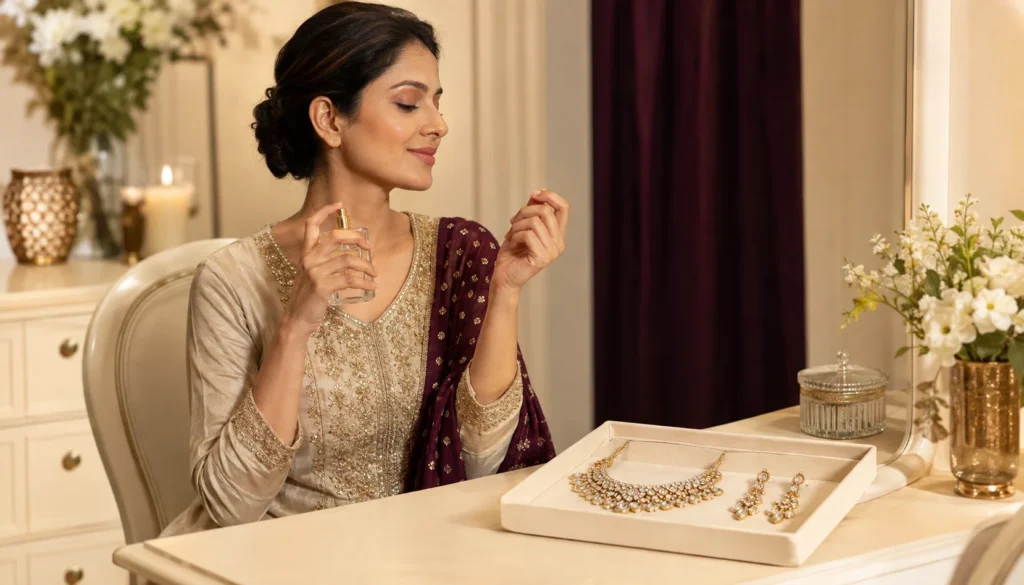
This is one of the easiest and most useful jewellery-care rules.
Your jewellery should be the last thing you put on while getting ready. It should also be the first thing you remove when you return home.
Follow this order:
- Apply your skincare.
- Apply sunscreen or body lotion.
- Complete your makeup.
- Style your hair.
- Spray your perfume.
- Allow everything to dry.
- Wear your jewellery last.
Perfume, hair spray, foundation, creams and lotions may leave a film on the jewellery. Some ingredients can make the finish dull or contribute to colour change.
The Gemological Institute of America warns that substances such as perfume, lotion, hair spray and cosmetics may damage or discolour metals and certain gemstones.
When you return home, remove your jewellery before changing clothes or removing makeup. This can stop chains from getting caught in fabric and reduce contact with makeup remover.
Simple rule to remember
Beauty products first. Jewellery last. Jewellery off first when you return.
This habit takes only a few seconds, but it can reduce direct chemical exposure.
2. Keep gold-plated jewellery away from water
Water is one of the most common reasons plated jewellery loses its shine.
One accidental splash may not always cause immediate damage. The greater concern is repeated contact with water, soap and moisture.
Remove your jewellery before:
- bathing;
- washing your face;
- washing dishes;
- swimming;
- visiting a spa;
- entering a steam room;
- doing laundry by hand; or
- cleaning the house.
Water can remain trapped around:
- clasps;
- chains;
- earring backs;
- raised stone settings;
- small design details; and
- the underside of necklaces.
If these areas stay damp, the metal may tarnish faster.
Swimming-pool water can be especially harmful because it contains chlorine. Sea water also contains salt. Both can affect metals and plated finishes.
GIA recommends removing jewellery before entering a chlorinated swimming pool or using household cleaners.
If your jewellery becomes wet by accident:
- Remove it as soon as possible.
- Pat it gently with a soft cloth.
- Do not rub it hard.
- Leave it in a clean, dry place.
- Store it only after it has dried fully.
Never use a hair dryer or direct heat to dry jewellery. Heat may affect stones, adhesives or decorative treatments.
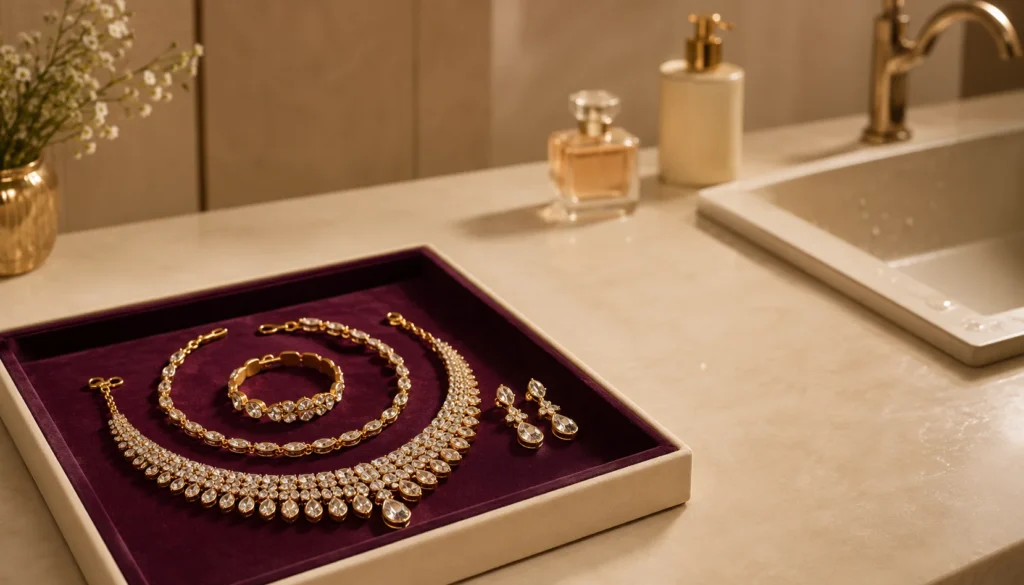
3. Protect it from sweat and skin oils
Your skin naturally produces sweat and oil. This is completely normal.
However, sweat contains water, salt and other substances. When it remains on plated jewellery for a long time, it may affect the surface.
This is especially important during:
- hot summer days;
- outdoor celebrations;
- long wedding functions;
- dancing;
- exercise;
- travel; and
- crowded events.
Rings, bracelets and close-fitting necklaces often receive the most contact with sweat.
Your skin chemistry may also affect how quickly a piece changes. Two people may wear the same type of jewellery and have different experiences.
One person may notice very little change. Another may see darkening sooner. This does not always mean that one piece is better or worse. Wearing frequency, skin chemistry and care can all make a difference.
Remove gold-plated jewellery before exercising. If you have worn it during a hot function, wipe it gently before putting it away.
Do not place sweaty jewellery directly into a closed box. Moisture trapped inside the box may speed up tarnishing.
4. Avoid perfume, sanitiser and household chemicals
Many products that are safe for your skin or home may still be too harsh for a plated surface.
Keep jewellery away from:
- perfume;
- deodorant spray;
- hair spray;
- hand sanitiser;
- bleach;
- floor cleaner;
- toilet cleaner;
- dishwashing liquid;
- nail-polish remover;
- strong detergent; and
- other cleaning chemicals.
Rings and bracelets are especially likely to touch handwash and sanitiser.
Before applying sanitiser, remove your ring if it is safe to do so. Allow your hands to dry completely before wearing it again.
Remove all jewellery before cleaning your home. Household cleaners may damage the finish, affect stones or leave harsh residue around the settings.
Do not spray perfume directly onto a necklace, even if you are already dressed for an event. Spray it on your skin or clothes before wearing the jewellery and allow it to dry.
A useful getting-ready habit
Keep your jewellery box away from your perfume bottles.
This reduces the chance of perfume mist settling on jewellery stored nearby.
5. Reduce rubbing and unnecessary friction
Friction means repeated rubbing between two surfaces.
Gold plating is an outer layer. Constant rubbing may slowly make that layer thinner.
Friction can happen when:
- two bracelets rub against each other;
- a bracelet rubs against a watch;
- rings touch a desk or door handle;
- necklaces become tangled;
- earrings touch metal hair accessories;
- a necklace rubs against rough embroidery; or
- jewellery pieces are stored together.
Rings often show wear on the lower side because that part touches tables, bags and other objects.
Bracelets may show wear near the clasp or where they touch a watch.
Necklaces may experience rubbing against heavy bridal blouses, sequins or embroidered fabrics.
You do not need to stop enjoying layered jewellery. Just avoid wearing too many plated pieces tightly against one another.
When wearing a heavy necklace with embroidered clothing, check whether sharp threads, beads or sequins are rubbing against its back.
Store each jewellery piece separately so chains, stones and metal surfaces do not scratch one another.
6. Wipe the jewellery after every wear
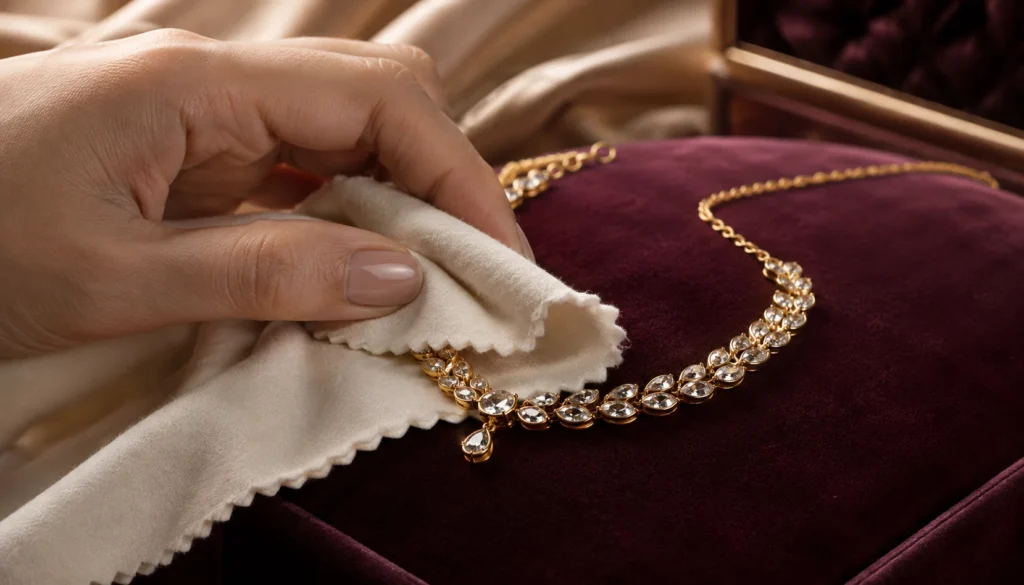
You do not need to give your jewellery a deep cleaning after every event.
A gentle wipe is often enough for regular care.
Use a clean, soft, dry, lint-free cloth. Microfibre cloth can also work if it is clean and not treated with strong cleaning chemicals.
Wipe:
- the front of the piece;
- the back that touched your skin;
- the inside of rings;
- earring posts and backs;
- necklace clasps;
- bracelet clasps; and
- areas around large stones.
Do not rub forcefully. Strong polishing can slowly remove the gold-plated layer.
The purpose is to lift away light sweat, oil and residue—not to polish the metal aggressively.
After wiping, allow the piece to rest in a clean, dry place for a short time. Store it only when it is completely dry.
Create a small care area near your dressing table with:
- one clean jewellery cloth;
- separate soft pouches;
- a lined storage box; and
- enough space to inspect each piece.
This can make regular care easy rather than tiring.
7. Clean plated jewellery gently and only when needed
More cleaning is not always better.
Gold-plated jewellery should be cleaned only when needed and with the gentlest suitable method.
Start with a soft, dry cloth.
If that does not remove the residue, check the product’s care instructions. Different jewellery pieces may contain different metals, coatings, stones and fixing methods.
If the care guide allows damp cleaning:
- Examine the jewellery for loose stones.
- Do not clean it at home if anything feels loose.
- Slightly dampen a soft cloth.
- Use only a tiny amount of mild soap if permitted.
- Wipe the surface gently.
- Remove any soap with another slightly damp cloth.
- Pat the jewellery dry at once.
- Allow it to air-dry completely.
- Store it only after all moisture is gone.
Do not soak stone-heavy jewellery unless the brand clearly says that soaking is safe. Water may collect behind stones or affect some setting methods.
Never clean gold-plated jewellery with:
- toothpaste;
- baking soda;
- lemon juice;
- vinegar;
- bleach;
- nail-polish remover;
- alcohol;
- acetone;
- metal polish;
- rough tissue;
- scouring powder;
- a hard toothbrush; or
- an abrasive polishing cloth.
These products may clean some unplated metals, but they can scratch or remove a plated finish.
Toothpaste is a common online recommendation, but it may contain rough particles. These particles can make the jewellery look brighter for a moment while damaging the gold layer.
When jewellery is plated, stronger cleaning is not better cleaning. Gentle cleaning is the safer choice.
8. Store every jewellery piece separately
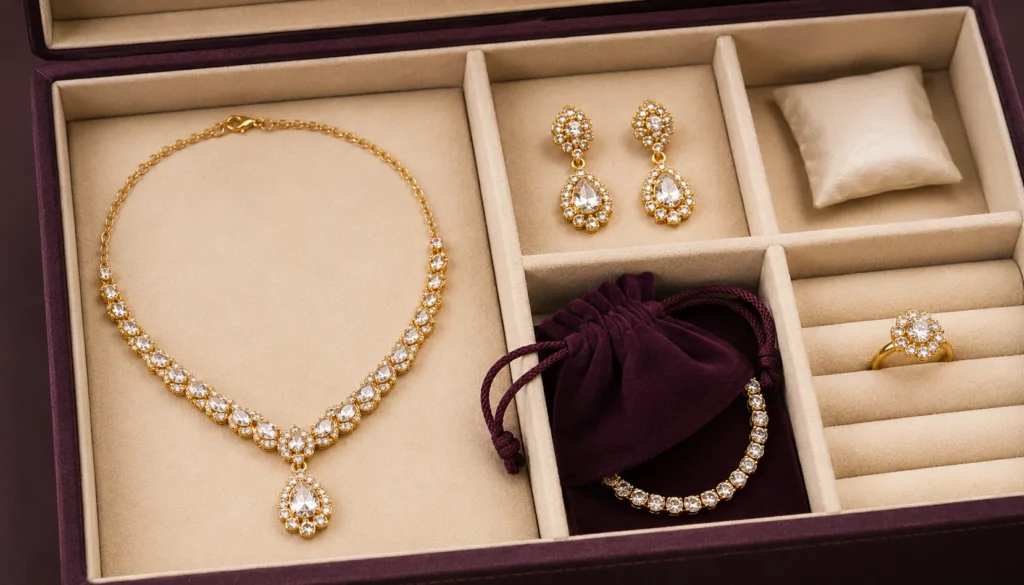
Correct storage is an important part of learning how to prevent gold-plated jewellery from turning black.
Do not leave your jewellery:
- on an open dressing table;
- inside a bathroom;
- near a kitchen;
- beside perfume bottles;
- against a damp wall;
- in direct sunlight; or
- mixed with many other pieces.
Open storage exposes jewellery to dust, moisture, perfume spray, room freshener and cleaning vapour.
Instead:
- Wipe the piece after wearing.
- Allow it to dry.
- Place it in a soft pouch or lined compartment.
- Keep different pieces separate.
- Close the pouch or box properly.
- Store it in a dry cupboard or drawer.
Keep earrings as pairs, but do not allow their sharp posts to scratch each other. Close chains before storing them so they do not become tangled.
Place heavy necklaces flat where possible. Hanging a very heavy necklace for a long time may place stress on the chain or clasp.
You may keep a closed silica-gel sachet inside the storage box to help manage moisture. Do not let the sachet rub directly against the jewellery. Keep it away from children and pets, and replace it when needed.
Never store jewellery before it has dried fully.
9. Take extra care in Indian summers and monsoons
India’s weather can be challenging for plated jewellery.
Hot summers increase sweat. Monsoon weather brings humidity. Dust and air pollution may also settle on jewellery that is stored openly.
During summer:
- avoid wearing plated jewellery while exercising;
- wipe the back after long events;
- do not store it immediately after outdoor wear;
- keep it away from wet towels and clothing; and
- allow it to dry before closing the storage box.
During the monsoon:
- keep the jewellery box away from damp cupboards;
- avoid storing it near windows;
- check the storage area for moisture;
- keep each piece in a separate dry pouch; and
- inspect pieces before important events.
Do not store jewellery in a bathroom cabinet. Bathrooms may remain humid even when the surfaces look dry.
If you live near the sea, take additional care because the air may carry both moisture and salt.
Indian weddings may involve several hours of makeup, perfume, dancing and heavy clothing. Wipe your jewellery gently after every function, even if you plan to wear it again the next day.
10. Choose thoughtfully finished jewellery from a trustworthy seller
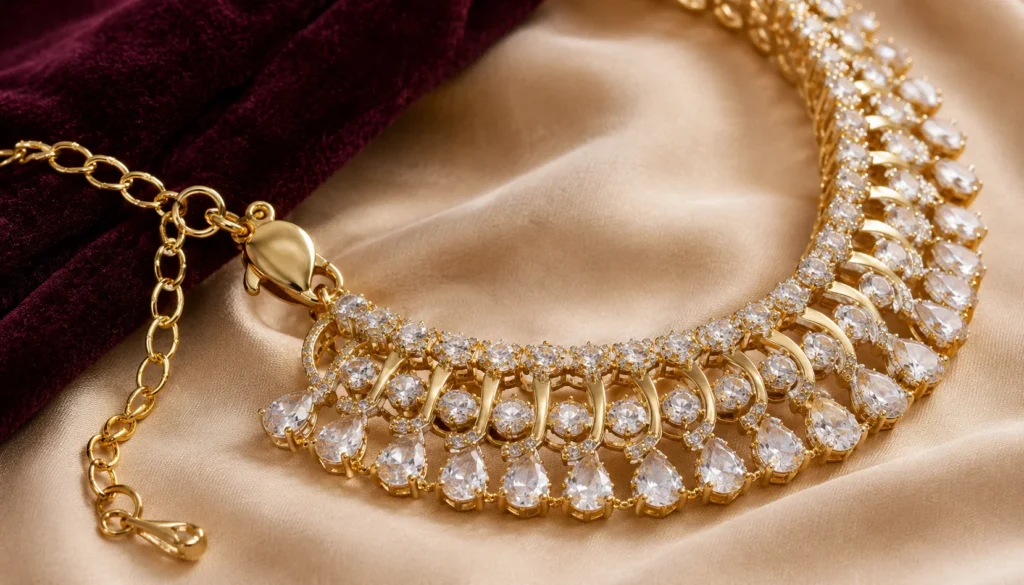
Good care cannot fully correct poor manufacturing.
The quality of gold-plated jewellery may depend on:
- surface preparation;
- smoothness of the base;
- consistency of plating;
- thickness of the plated layer;
- quality of the stone settings;
- strength of clasps and hooks;
- finishing of the edges; and
- overall construction.
The karat value of the surface plating is only one part of the story. A higher karat description does not by itself guarantee that the finish will never fade.
You should also look at how the piece is made and described.
Check the gold tone
The colour should appear refined and balanced. Look for obvious patches or areas where the tone seems uneven.
Look closely at stone settings
American Diamond or decorative stones should appear neat and properly aligned. There should not be visible glue, large gaps or rough prongs.
Examine the edges
Edges and joins should look smooth. Rough areas may feel uncomfortable and may also show poor finishing.
Test the clasp
The clasp or hook should close securely. It should not feel loose or weak.
Check the back
Premium-looking jewellery should not only look beautiful from the front. The back and underside should also feel carefully finished.
Read the product description
A trustworthy product listing should explain:
- that the jewellery is gold-plated;
- what kind of stones or decorative materials are used;
- approximate size or dimensions;
- what the package includes;
- how to care for the jewellery; and
- the relevant return or claim process.
Be careful with unrealistic promises
Claims such as these should be treated carefully:
- “will never tarnish”;
- “permanent gold colour”;
- “no care is required”;
- “wear it in water every day”; or
- “exactly the same as solid gold forever.”
Well-made plated jewellery can offer beautiful, premium-looking wear. However, its appearance still depends on the plating, frequency of use, skin chemistry, storage and care.
Clear information is a stronger sign of trust than an impossible promise.
A simple care routine for weddings and celebrations

Use this routine whenever you wear plated jewellery to an important event.
Before the event
- Complete your skincare and makeup.
- Apply perfume and hair spray.
- Allow beauty products to dry.
- Check the clasp, hooks and stones.
- Wear the jewellery last.
- Carry a soft pouch if you may remove it later.
During the event
- Avoid spraying perfume near the jewellery.
- Keep sanitiser away from rings and bracelets.
- Do not clean the jewellery with a wet tissue.
- Dab sweat gently without rubbing the piece.
- Keep heavy necklaces away from rough embroidery where possible.
After the event
- Remove the jewellery before changing clothes.
- Hold it carefully by the stronger areas.
- Wipe the front and back with a soft dry cloth.
- Let it dry fully.
- Store each piece separately.
- Do not leave it on the dressing table overnight.
This routine is especially useful during multi-day weddings, when the same jewellery may be worn more than once.
How can you tell whether jewellery is dirty, tarnished or faded?
Before cleaning a dark piece, look at it carefully.
Surface dirt
Dirt or cosmetic residue may look grey, greasy or dull. It may collect behind stones and around clasps.
A gentle wipe may remove it.
Tarnish
Tarnish may appear black, brown, grey or greenish. It happens when a metal reacts with moisture, air or another substance.
Fading
Fading happens when the gold colour becomes lighter or uneven. You may begin to see a different colour below the surface.
This usually means the plated layer has become thin in that area.
Scratching
Scratches appear as lines or worn patches. They are often caused by jewellery pieces rubbing together or by contact with hard surfaces.
Cleaning may remove dirt, but it cannot replace gold plating that has already worn away.
What should you do if your gold-plated jewellery has already turned black?
Do not use a strong cleaner immediately.
Follow this process.
Step 1: Stop wearing it temporarily
Remove the jewellery and inspect it in good light.
Check whether the darkening is:
- across the whole piece;
- only around the clasp;
- behind the stones;
- on the parts touching your skin;
- limited to high-friction areas; or
- only present on your skin.
Step 2: Use a soft, dry cloth
Wipe the surface gently. If the dark material comes away, it may have been dirt, oil or cosmetic residue.
Step 3: Follow the product’s care instructions
Do not use a general home remedy without knowing the jewellery’s construction.
Stone-heavy pieces, glued elements, pearls and treated materials may need different care.
Step 4: Contact the seller if the product is new
If a new product turns black after limited and careful wear, contact the seller.
Share:
- your order number;
- clear photographs;
- a close-up video if needed;
- when you first noticed the change;
- how the jewellery was worn;
- whether it touched water or chemicals; and
- how it was stored.
This information can help the seller examine the concern fairly.
Step 5: Ask about professional cleaning or replating
If the gold-plated layer has worn away, cleaning cannot put it back.
A jewellery professional may recommend:
- gentle cleaning;
- polishing;
- repairing the clasp;
- resetting a stone; or
- replating the jewellery.
Not every piece can be replated safely. Its design, materials and stone-setting method must first be checked.
How long can gold-plated jewellery last?
There is no honest single answer.
The life of the finish depends on:
- plating quality;
- plating thickness;
- surface preparation;
- the metal below the plating;
- how often you wear the piece;
- how much friction it receives;
- your skin chemistry;
- contact with sweat or perfume;
- cleaning methods; and
- storage conditions.
An occasion necklace worn carefully a few times a year may keep its finish longer than a ring worn every day.
Rings and bracelets usually receive more rubbing. Earrings may receive less friction, but hair products and perfume can still affect them. Necklaces may come into contact with sweat, makeup and embroidered clothing.
Instead of asking only, “How many years will it last?” also ask:
- How often will I wear it?
- Is it for everyday use or celebrations?
- Will I keep it away from water?
- Can I store it correctly?
- Does the seller provide proper care guidance?
Your answer to these questions can help you choose and care for the jewellery more intelligently.
Common myths about gold-plated jewellery turning black
Myth 1: Blackening always means that the jewellery is fake
Not true.
A plated product has gold on its surface and another material below. Darkening may happen because of dirt, chemicals, wear or tarnish.
Myth 2: Higher-karat plating can never fade
Not true.
The karat value does not tell the complete story. Thickness, finishing quality, wear and care also matter.
Myth 3: Toothpaste is the best jewellery cleaner
Not true.
Toothpaste may scratch the plated surface and remove more of the gold layer.
Myth 4: Premium jewellery does not need care
Not true.
Better construction and finishing can support lasting beauty, but every plated surface needs sensible care.
Myth 5: Jewellery is safe inside a bathroom cabinet
Not always.
Bathrooms are often humid. The moisture may speed up tarnishing.
Myth 6: Blackened jewellery must be thrown away
Not always.
The jewellery may only need careful cleaning, professional repair or replating.
Myth 7: Anti-tarnish means permanent colour
The term may describe a finish designed to resist tarnishing, but no finish should be treated as permanent under every condition.
Wear, chemicals, water, sweat and storage can still affect it.
Frequently asked questions
1. How can I prevent gold-plated jewellery from turning black?
Keep it away from water, perfume, sweat and cleaning chemicals. Wipe it after use, allow it to dry and store every piece separately in a dry pouch or box.
2. Why does gold-plated jewellery turn black after wearing?
Sweat, skin oil, perfume and friction may affect the surface. If the plating becomes thin, the metal below may be exposed and start to tarnish.
3. Does blackening mean that the jewellery is fake?
No. Blackening alone does not prove that jewellery is fake. Even genuine gold-plated jewellery can tarnish because of wear, moisture or chemicals.
4. Can sweat turn gold-plated jewellery black?
Sweat can contribute to blackening because it contains water and salts. Wipe the jewellery gently after wearing it during hot weather or long functions.
5. Can perfume damage gold-plated jewellery?
Yes, repeated or direct perfume exposure may dull or affect the surface. Apply perfume first, let it dry and then wear your jewellery.
6. Can I bathe while wearing gold-plated jewellery?
It is better to remove it. Water, soap and shampoo may affect the finish and collect around clasps or stones.
7. Can I swim while wearing gold-plated jewellery?
No. Chlorinated and salty water can damage the surface. Remove your jewellery before entering a swimming pool or the sea.
8. Can I wear gold-plated jewellery every day?
You can wear it regularly, but frequent wear creates more friction and contact with sweat, water and beauty products. Rotating your jewellery may help the finish last longer.
9. How should I clean gold-plated jewellery?
Start with a clean, soft, dry cloth. Use damp cleaning only if the product’s care instructions allow it. Never scrub the surface.
10. Can I use toothpaste on gold-plated jewellery?
No. Toothpaste can be abrasive and may scratch or remove the gold-plated finish.
11. Can I use lemon or baking soda?
They are not recommended. Lemon is acidic, and baking soda may be abrasive. Both can damage a plated surface.
12. How should I store gold-plated jewellery during the monsoon?
Store every piece separately in a dry, closed pouch or lined box. Keep the box away from bathrooms, damp cupboards and open windows.
13. Why does my skin become green or black after wearing jewellery?
Sweat and skin products may react with exposed metal and transfer colour to your skin. Stop wearing the item if you experience itching, swelling, burning or a rash.
14. Can blackened gold-plated jewellery be restored?
Surface dirt may be removed with gentle cleaning. If the plating has worn away, the piece may need professional replating.
15. Does 22-karat gold plating guarantee permanent colour?
No. The karat value describes the gold used in the plated layer. It does not guarantee permanent colour. Plating thickness, construction, wear and care also affect durability.
16. Should I store jewellery in plastic bags?
Use the pouch or storage method recommended by the seller. If using a suitable clean storage bag, ensure the jewellery is completely dry and does not rub against other pieces.
17. How often should I clean gold-plated jewellery?
Give it a light, gentle wipe after wearing. Deeper cleaning should be done only when needed and according to the product’s care instructions.
18. When should I contact the seller?
Contact the seller if a new piece changes colour after very limited and careful use, arrives damaged, has loose stones or appears materially different from its listing.
Conclusion
Learning how to prevent gold-plated jewellery from turning black is mainly about creating a few simple habits.
Wear your jewellery after applying perfume and makeup. Remove it before bathing, sleeping, exercising or cleaning. Wipe it after use, let it dry and store every piece separately.
You should also remember that gold plating is a surface finish. Its life depends on quality, use, skin chemistry, weather and care. No plated product should be expected to remain unchanged under every condition.
Thoughtful care does not mean keeping your jewellery locked away. It means wearing it confidently while protecting it from avoidable damage.
At Jyoti Luxe, jewellery is chosen to help women feel beautifully dressed, confident and distinctive during important celebrations. Clear product information and honest care guidance are an important part of that promise.
Because luxury is not only about how jewellery looks when you first wear it. It is also about understanding its beauty and caring for it wisely.
Beautifully Dressed. Unmistakably You.